Saturday, December 18, 2010

Holiday Greetings

Merry Christmas, and Happy New Year to all!
My older daughter, Janet, her husband Jonathan, and their three children, Abby, Ellie and Jamie will be here for a ten day visit over the holidays so I won’t be posting again until after the New Year. I am really looking forward to a lot of hugs and family time. We will spend some time in my village and some time seeing the sights, so I will probably have a lot to tell you all about after they leave.

Change in the weather
At the beginning of December there was a sudden change in the weather. It started getting cool, even cold, at night. It feels quite nice to step outside after sunset and feel a cool breeze, but if I have my windows open, I am actually cold at night. In any case, I am glad I brought a fleece jacket and a sweater. It warms up as soon as the sun comes up, but is not so beastly hot as in October, and I am not sweating off all my liquids during the day any more. I guess this beautiful weather lasts only about three months and then it goes back to hot, hotter and hottest for the rest of the year. I am trying to enjoy this while I have it.

Windows
The windows here do not have glass in them but are simply metal louvered shutters. When you close them they keep out the rain, and they do help keep the heat in the house at night now. They also darken the room and provide privacy, but the dust and dirt still come through. On a normal house, so do the insects. One of the requirements of Peace Corps housing is screens on the windows, so the insects do not get in through the windows at my house.

Building
With the end of the rain and with the crops in, it is time to do the building. People mix straw and mud, fill rectangular forms with the mess, and set them in the sun to dry. In a couple of days you have mud bricks, like these:


To build a house or a wall, you get a bunch of these bricks, map out the size of the thing you want to build, and start laying them, like ordinary bricks. For a house you might have a concrete floor, but maybe not. The wall is simple set out on the ground. For mortar, all you use is more mud. Here is an example of a wall, in progress:


To keep the whole thing from washing away when it rains during the summer, you cover it with another layer of mud, this time mixed with concrete or some other, stronger material, kind of like spreading stucco on a house. This layer has to be refreshed every few years, or your wall or house will wash away.

They also make concrete blocks in much the same way. Get your sack of concrete, mix it on the ground with sand and water, dump the mixture in a form, wait a bit, and let it dry in the sun. If you are making concrete block, you have to water the blocks so they don’t dry too fast and crack.

Hangar
Another thing you want to have here for most of the year is a good shady place. If you don’t happen to have shade from trees, or if your trees drop their leaves in the hot season, as most of them do, you build a hangar. This is just shelter made out of poles and woven grass mats. The mats are quite pretty and this is quite effective, but the material degrades over time and has to be replaced every couple of years, of course.

Courtyards
A typical house will be in a courtyard. There may be only one house, or several houses inside a wall. The houses usually consist of just a couple of rooms. In a typical, more modern one, there is a living room and one or two bedrooms with an indoor place to take a bucket bath, AKA shower. There may be several houses like this for family members, and some may consist of as little as a single room. Most of the living goes on in the courtyard, however, where cooking is done over a fire built under a pot sitting on three rocks.

When a visitor arrives (like me) the kids run into the house to get “a place” (chair) for you, and put it in the shade. To make a courtyard, you need a wall. This serves the purpose of delimiting you more or less private space and may keep animals in at night, or out during the day

Sheep vs Goats
Speaking of animals, can you tell which of these is a sheep and which is a goat?


There are some that look even more similar than the ones in these pictures. Do notice that there is not much wool on the sheep, and this is winter! No, I have not taken up raising animals. These guys belong to my neighbors. You can see their wall, covered with the protective coating, and how big this corner of their court yard is. This is about ¼ of their courtyard. They keep about 15 sheep and goats, a flock of chickens, a flock of guinea fowl, a couple of dogs and a cat. Good thing they have some space.

Saturday, December 4, 2010

Exploring Churches

When I arrived in my village one of most common inquiries from new acquaintances was about the church I would attend. Many of the people I know best here are Catholic and some go to mass every day. In fact the first church I did attend was the Catholic church, for the wedding mass for my community homologue’s daughter. There are a couple of European priests and a Burkinebé priest as well as at least one African brother, who happens to speak very good English. All of the Masses are in Moore, the local language, of which I now understand about 10 words beyond the simple automatic greetings you say over and ever every day, so that would not be a good choice for me, either from the religious stand point or from the stand point of having a clue about what was being said.

Protestant church #1

My homologue was very concerned that I get connected with one of the protestant churches so she took me to meet the pastor of a church that is not too far from my house. They have a three hour service each Sunday. The first hour, 8-9, is billed as the sermon, the second hour, 9-10, is for singing and the third hour, 10-11, is for prayers. I said in the US church services tend to last about an hour, not three, and the Pastor assured me it would be fine if I just came for part of the morning so I said I would attend the middle part, with the singing. He promised to have someone to translate for me. I arrived about 8:50 and they had put a chair for me way up in the front of the church. I indicated I would rather sit in the back, thank you, and they moved the chair. All the members of the congregation, which was not very large at this point, were seated on benches, men on one side, women and children on the other. A man came and sat next to me on a bench. A woman was reading, in Moore, from a booklet. My translator had a copy and he translated very rapidly into French, but it was too fast for me to follow and I have trouble hearing two things at the same time, especially when I don’t understand either of them.. There was a lot of room on the benches, but after the sermon part of the service the children, who had been having a Sunday School lesson or choir practice under the trees, came in, along with a lot of other people, and it was pretty crowded. Once the singing started the man again tried to translate the words for me, but I told him to forget it. I could not hear him because the volume of the singing and drumming was too loud, and I could not understand most of his French even when I could hear him.

There were several groups who sang: a group of teen aged girls, the Sunday School kids, a group of women, a group of boys, and so on. The choir director sang, as did a woman soloist. For all the singing the only accompaniment was drumming, which was loud and enthusiastic. The little church was packed and when everybody sang, the sound was overpowering. The kind of singing that is considered good for choirs here is the kind of sound every American choir director tries to get rid of, that is to say, singing as loud as possible, in a rather nasal tone. When they are on the last verse of a song, the director had them sing more softly, which sounded great to my ear, but on the last line they return to the usual loud, sing-out-at-the-top-of-your voice sound. In addition to the voices, there was a lot of clapping and swaying. One of the children’s groups had a little dance to go with one song. It was dancing in place, but resembled the kind of movements I have seen in the traditional dances.

After an hour I decided I had had enough and left. The pastor came out to say good bye and I thanked him for trying to have a translator for me, but explained that I could not hear clearly with two things going on at once. I attributed it to a hearing problem and apologized, but said I would not be back until I understood more of the local language.

Protestant Church #2
Next my homologue took me to meet the pastor of the big church in the center of the neighboring town. I say big, but it is not as large a building as the Catholic church. They have a service that starts at 7:30 on Sunday morning, in French, which I have a chance of understanding, so that is the place I have been going. They use a book that is the same as the one they were using at the other church, but in French. It is essentially a Bible study book, put out by the national church office here, or maybe it is for all of West Africa. The church clearly produces these lessons both in French and some of the local languages. In any case, I understand a bit of what is being said, and it is good practice for trying to understand spoken French. Both of these churches are Assembly of God, quite a bit more conservative than my comfort zone, but which seems to be the only protestant church in this area, and maybe in all of Burkina Faso.

I asked the pastor if I could get a copy of the book they were using, thinking I might understand better if I could follow along, and he came up with one for me. He also loaned me a copy of the Bible in French, too. Interestingly it is a study Bible, translated by Catholic missionaries, so the Old Testament has the books of the apocrypha interspersed with the books in the protestant Old Testament. In this church there are several men who participate in leading the service. I found out that they are something like lay ministers, and have had three years of training. They not only help with the service but visit the sick and help deal with problems in the congregation. In addition to reading the little book, the lay ministers, and sometimes the pastor, sermonize a bit about each section. I do OK when they are reading from the book and I can see what they are saying, but still have trouble understanding what they say when I can’t see it.

Before and after the reading from this book and the sermonizing there are prayers. I have yet to figure out if all the people are just saying their own prayer or if they are all reciting the same prayer, just at different speeds. Sometimes I think they are saying the same prayer and it is a race to see who can finish first. At other times the leader rings a little bell to indicate it is time to stop. In any case, I can’t understand a bit of it. There is also some singing by the congregation, from a song book that has the words in French. Some have familiar tunes, and one of the lay ministers who sits near me shares his copy of the song book if he can find the page. There is also a small choir, that arrives piecemeal throughout the sermon time. They have a drum to accompany them, but there is also a girl who has a half of a gourd (a calabash) with a bunch of shells around the edge. She tosses it in the air and catches it, in rhythm with the beat of the drums. The choir director and two young men usually sing a trio, with a guitar! It is the only musical instrument I have seen in either of these churches. There is sometimes another group who sings, usually with the lay minister who shares his book with me leading the group. I am not sure how much of a religious experience this is, but it puts my face in the community and helps people place me as a protestant. I think it may improve my French listening skills so I don’t mind biking 20 minutes each way to attend.

One other thing is worth mentioning about this church. At the service I attend, most of the people who come are what they call functionaries, that is, they have jobs with a salary. In this service they pass a basket for the offering, much like in the states. There is, however a table at the front of the church, and as people are entering for the next service, in Moore, some bring a bag of grain or whatever they grow, or a casserole dish, which I assume has food in it as well. I have also seen poles with little mesh baskets, like fish nets, on the ends which I assume get passed in the Moore service as well.

The Muslims

I realized I had contacted the Protestants and Catholics, but not the Muslims and I did not want to neglect them. It took a little while, but eventually my homologue found a Muslim neighbor who was willing to introduce me to the Imam. He seemed like a very nice fellow and happy enough to meet me, although the whole conversation was in Moore except what I had to say in French, with my homologue translating for me.

Sunday, November 28, 2010

Health update

A word about my health and other health topics

I was doing fine health-wise until a couple of weeks ago when I picked up a water born parasite called giardia that gives one nasty cramps and other intestinal distress. I was going to Ouaga for a check of some skin spots anyway, but went a day early when I found I was hot, not just because it was 90 degrees or so but because I was running a fever. They kept me there for 10 days, which was a good thing because I lost more weight and was feeling tired all the time. The Peace Corps takes very good care of our medical problems. The dermatologist assured me that the places on my skin I thought might be a problem were not, and I regained my appetite so now I am back at my site and feeling fine. That is also the reason I was fortunate enough to be in Ouaga for Tabaski. Now on to health issues for the locals.

Malnutrition
I have been going to the local maternal health center twice a week to “help” (mostly to get in the way and scare the babies) with the baby weighing. All of the babies born in the town are supposed to come once a month to be weighed and to be vaccinated at the appropriate times. Vaccinations of various kinds are free to the people who bring in their babies, but not all babies come in on the proper schedule. The mothers have a little booklet in which the midwife made notes about the pregnancy. After the baby is born his or her name is added to the book and a record is made of the baby’s weight each month. We have a book that stays in the center that lists each baby born in the town. When the mother brings the baby in, the official worker, who can speak Moore, checks the mother's book to see the baby is there on the right day, has the mother put the baby on the scale, and records in the mother’s book both the weight and whether the baby’s weight is > 100%, > 90%, > 80%, >70% of the expected weight for a child that age. If the baby is 70% or less of the expected weight, the baby gets an examination by the “sage femme” that is, wise woman, or midwife, and the mother gets a consultation about the baby’s problems. The mother is then supposed to bring the child back weekly to keep track of progress and for the midwife to talk further with the mother about better nutrition. Some of these kids are easy to spot at the health service. Often they have reddish hair and a very swollen belly, along with very thin arms and legs.

Up the road a bit is a medical center connected to the Catholic Church where I went for the wedding of my community homalogue's daughter. I met one of the nuns at the wedding, who happens to be American, and she gave me a tour of the facility. They treat severely malnourished babies there, but their main mission is to teach mothers how to make a nourishing baby cereal by combining ingredients they can easily obtain in their villages. For example, cereal that combines a grain, such as corn or millet, with either beans or peanuts, will provide a complete protein for the baby.

This Sister goes out on her moto to visit remote villages that are too far away for most people to be able to bring the children in. She has trained someone in each village to take a simple tape measure and measure the upper arm of each child under 5 in the village. The area of the tape that measures the smallest circumference is red, the next yellow and the rest green. If the arm measurement falls in the red or yellow area, chances are the child is malnourished. She visits the villages every three months for a year, weighs the children, and talks with the group of mothers whose children have been identified as being malnourished. For people who live closer, she tries to get mothers to come to the center to learn how to prepare more nutritious food. There is a big room at the center, with lots of openings to the outside air, in which there are wood burning “stoves” where the mothers cook as they would at home. They also make bags of the cereal with they give or sell, I am not sure which, to the mothers. This seems like a very fine program.

Government Health Care
I have mentioned the maternity and baby part of the government supported health service, but I should say there is another building where people with health problems can come for consultations and prescriptions, and there is a dispensary for giving out drugs. I am pretty sure there is a charge for this service because people have tried to get me to give them medicine for some kind of problem. We were warned this might happen and given strict orders never to share our medications with others so I have to tell them, “No, I am not a doctor or nurse and I have been forbidden to give out any drugs.”

Polio
There is a real problem with polio in Africa and there is a big push to get all children immunized. In November there was a big country wide campaign to get all the children under 5 immunized, regardless of whether they had already been immunized or not. The idea is that, if all children are immunized it will be possible to end this epidemic.

In the town near me, and in other towns I believe, there are centers for handicapped people. Many of these folks have problems with their legs and they get around on big tricycles. The peddles have been placed up by the handle bars and they “peddle” with their hands. Some of them can move pretty quickly. There are also folks who have to use a crutch, like the guy in my favorite little store. They create original arts and crafts or work as tailors, or at other jobs that do not require a lot of moving around or strength. I believe most of these folks are polio survivers, but there are probably other reason for the handicaps.

More on the neem tree
I had the name wrong for that tooth brushing tree. The tree is the neem tree, known in its native India as the tree of 40 because it is said to cure 40 diseases, according to Wikipedia. It is apparently good for more than just cleaning teeth. Check out the article if you are interested in all the things it is supposed to be good for that have not been substantiated. They claim it is drought resistant and evergreen. We shall see about that in the spring when it is really hot and dry.

Friday, November 19, 2010

Tabaski

For those of you who do not know, Tabaski is an annual festival in the Muslim faith that is the beginning of the new year. It commemorates the day when Abraham showed his obedience to God by being ready to sacrifice his only son, and the fact that God then sent a ram to be sacrificed instead, so the son did not die. In the Judeo-Christian tradition the son was Isaac, of course, but in the Muslim tradition that son was Ishmael, through whom they trace their heritage back to Abraham. In any case, it is a big religious festival and a legal holiday here. Every family that can afford it buys a sheep, kills it, and has a feast.

I was fortunate enough to be in the capital for another reason at that time, and to have just met an acquaintance of my son in law here, who very kindly invited me to join him and his family for the fete. I did not get in on the sheep sacrifice part of the day, nor did I go to the mosque. My escort, who works in the government here, picked me up (in his car, no less) about 1 in the afternoon and our first stop was at the home of his secretary. He gave her one of the ubiquitous black plastic bags everything is put in here when you buy anything. I think it had some of the meat from his sheep, but I am not sure. The women in the family were in the court yard, preparing the mutton and other food. We were escorted into the house and served pineapple juice. Then the secretary brought a plate of French fries and fried plantains, and another plate with several pieces of grilled chicken. I ate only a little because he had warned me that on this day you are expected to visit many people and eat everywhere you visit.

Next he took me to his house where there were quite a few people gathered. Some were seated on the front terrace and others in the living room. I was invited to sit in the living room where there were overstuffed chairs and couches to seat about 9 people. I sat there and tried a drink made from the sap of the palm tree. It was not bad, but had a bit of a bite to it. I still wonder if it was not a bit alcoholic. I assumed it would not be because Muslims do not drink alcohol. Later those of us in the living room started the line to the food. First there was of a big plate of crudité, that is, all sorts of raw vegetables, cucumbers, onions, tomatoes (green) canned corn, grated carrots and I don’t know what else, with a yummy dressing. Then there were the French fries served with an onion and tomato sauce in place of ketchup, fried plantains, baked fish, couscous, very well cooked lamb, and grilled chicken. Having eaten my fill, it was time to visit another house.

He drove me to the fancy part of town, called Ouaga Deux Mille, that is, Ouaga 2000. It is the new area near the presidential palace where there are a number of government offices, embassies, and very upscale houses for the high up government officials, I think mostly at the level of cabinet ministers. There were a lot of people there, all dressed in their holiday clothes, and here I was, this ancient American woman wearing my traveling clothes. I was glad that my blouse was the one made of the material celebrating the 8th of March, International Women’s Day, so I was not a total western interloper.

At the gate there were guardians, like for all big important houses, but these were dressed in camouflage fatigues so I think they may have been military. Happily, no guns in sight, however. As at my host’s house, there were several seating areas. First there were those seated outside. Then there about 20 men seated on one side of the six sided entry hall. In the center of this hall was a gravel pit, about 10 X10 feet, with a banana tree or some other tropical tree, growing up toward the sky light a couple of stories above. On another side there was what was clearly to be the buffet line, and another set of doors opened into the air conditioned “great room.” There were a couple of seating areas for 10-15 people. We greeted folks at the first one and ended up seated in the second one. At first I was seated in one of those plastic lawn chairs that serve the function of folding chairs here, but very quickly I was asked to stand for a second so they could replace it with a padded chair from a rather elegant dining room set. And THAT is a sign of respect, folks. You get the really good chair if you are an honored guest. My host introduced me as a Peace Corps volunteer and the mother in law of a colleague in American and that was about all the conversation about me.

In any case, after a few minutes it was time to start the buffet line and our room was invited to go first. The choices were rather similar to those at my host’s house, but there were a few differences. In addition to the things he served, there was to and sauce, although the sauce had big chunks of chicken in it, which is not your usual to sauce! The mutton was being sliced by a carver, as you might see at a fancy buffet in the states, and was pretty tender.

After all of the people in our seating area had eaten a server brought over a bottle of Champaign and one of red wine. Only about half the folks accepted and I found out later that, in fact, Muslims will serve alcohol to guests because they know others expect to have wine with meals. The only rule is, they will not serve too much, so as not to cause problems for their guests. It is also possible that the minister and his family are not Muslim, becasue everybody celebrates all the holidays here, regardless of their religion. I had been introduced to the minister on the way to the buffet line and had a chance to thank him on the way out. We were escorted to the front gate by his wife, again a real honor.

We returned to my host’s house were the people who work under him were paying their duty calls to give good wishes for the fete and the new year. Some of them had met my son in law and I knew they really did know him from the little French I could understand, “the big guy with the beard who talks fast and negotiates hard.” That’s him, all right.

By 5:00 it was time for the neighbors to start calling and for my host to go visit neighbors so I asked to be taken back to my living place, having seen the general idea of the fete, having eaten way too much, and being rather tired. What an adventure!

Friday, November 12, 2010

Health

There is, of course, a lot of illness and disease here in Burkina Faso. The thing you hear about the most is malaria. Just a few weeks ago the government health service in this part of the country gave out free mosquito nets to people in the villages who had signed up to receive them. I, of course, have been sleeping under my Peace Corps issued mosquito net or in my Tropic Screen Tent ever since I arrived and taking my anti malaria drugs faithfully.

In spite of putting on insect repellant every day, I still get mosquito bites. Malaria is carried by the mosquitoes that are out in the evening, hence the value of sleeping under a mosquito net. My Peace Corps friends in the health service say that people tend to say they have an attack of malaria (the palu) whether it is malaria or a cold. There is, however, an anti-parasite drug that people get treated with when they have malaria. Several people I know, or their children, have been in the hospital and were treated with this drug, so I am sure many of those who say they have malaria actually do. I hope the new mosquito nets help. The data suggest that using them significantly reduces the chances of getting the disease.

Teeth

One of the most obvious signs of poor health is the condition of people’s teeth. So many adults have missing teeth that it is surprising to see someone with all of them. Often you see a smile with big gaps in it, or only one or two teeth visible. Sometimes you see decayed stumps in the mouth. Pretty sad. There are tooth brushes and tooth paste available at the local stores, but the most common way to clean teeth is to grab a twig off a tree and rub your teeth with it. It turns out this is not just any old tree, but the mim tree. One of my friends stripped a twig of it for me to try and it is pretty bitter. It must have some particular chemicals under the bark. Some people who use them a lot seem to have pretty good teeth, so maybe it is one of those reasons to preserve biodiversity. It may be the next new ingredient in your tooth paste. Who knows? Another friend told me that it works best if combined with sodium, which you can buy at a boutique or the marché. He said that, if you don’t have money for sodium, you can crush salt and use that powder. He has great teeth, so he is a pretty good testament to the effectiveness of this method.

Truffela Trees

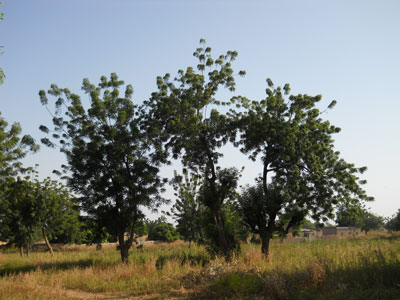
If you are a Dr. Suess fan you know about truffela trees, that were all cut down to make sneedes. (Dr. Suess aids the environment.) Someone pointed out that in some of my pictures there are trees that remind one of truffula trees. They are the mim trees, mentioned above, and here is a picture of one. Compare it to the book, if you have one at your house.


Eyes

I have been struck by the number of people with a lazy eye, that is, one that does not focus with the other. You see this in children and adults. You also see people who are clearly blind in one eye. I am sure many people who need glasses do not have them because the only people with glasses are the functionaries, that is, the people who receive a salary

Umbilical Hernias

It amazes me how many of the children have huge umbilical hernias. They may protrude several inches. Most of the young kids run around naked, or nearly so, so it is something you can easily see. Because clothes tend to be quite loose, and often rather ragged, you can see that these hernias are not a new thing. Adults have them, too. I don’t think it matters whether the baby was born at the maternity or at home, but I will keep an eye on the babies I see at the baby weighing

Saturday, November 6, 2010

Harvest Time

Here we are at the beginning of November. The rain has ended and it is harvest time here in Burkina Faso. When the millet has ripened, people go out and cut the grain bearing part off of each stalk. You see donkey carts or big bowls balanced on people’s head going from the fields to the courtyards, where the grain is dried in the sun, removed from the stalk, and stored to be used later in the year. The peanut plants are pulled up and carried home in the same way. As I mentioned before, there were beans growing up the millet stalks, which were harvested a while ago. In some fields you now see the gourds, used to make the calabashes for eating and drinking that have also been growing among the millet.

After the grain is removed, the stalks of the millet plants are cut down and left to dry. They can be used as animal fodder during the dry season, when nothing grows, or woven into mats to be used to create shade, like the hangar I showed you in the demystification entry. To build a hangar you need poles. Because it is against the law to cut down trees here I wondered where they were coming from. Then I heard chopping from semowhere down one of the paths by my house. I looked out to see a neighbor up in a tree, cutting off a couple of branches. It is really just pruning the tree, and it will grow two where one was removed, I guess. Below is an example of this kind of pruning. I did not get the top of the tree in the first picture because I had no idea they were going to prune it. I was get taking general picture of the countryside. I am standing in front of this tree in the picture in the pagna blog, so you can check it out there, too. The top used to be much higher than the part that is left. Maybe you can get an idea from these pictures of how much was “pruned” to get wood for the fire and for a new hangar.


Another thing that happens is that the animals, which have been carefully tethered to stakes pounded into the ground, away from the crops, during the growing season are now set free to roam and graze at will. One day I was surprised to hear cattle lowing and a loud rustling sound. I looked out my window and saw a herd of 50 or more cattle wandering through the millet field behind my house. I had not seen many cattle here, but there were a lot that day! I did not see any cows, only “beef” as they say here. They sure do make a lot of noise!

I asked a neighbor about whether people were upset to have the animals grazing in their fields, and he told me there is a person who tells the village when it is OK to let the animals graze freely. I guess if you are slow getting your crops in, it is just too bad for you. Now there are pigs and piglets of various sizes, goats and sheep with lots of baby goats and sheep, chickens and guinea fowl with their chicks, as well as the cattle and donkeys, roaming everywhere.

Bats are gone

It appears that the poison gas attack was successful in getting rid of my bats, that is to say, killing them all off. They removed the dropped wooden ceiling in one of my rooms and the smell from the attic is terrible. Now I am waiting for the carpenter to go to the nearest big town to make the lath that will hold up the bigger pieces of light plywood that form the ceiling. Interesting to have to make lath! I have to keep the door to that room shut and hold my breath when I walk past it. Hopefully it will have a ceiling and the smell will be confined to the attic soon.

Now that the bats are gone, I thought I could sleep at night without being awakened by critters, but the other night I was awakened by the rustling of paper. Yikes! What was that? I knew it could not be a person because my house is very secure. I told myself to go back to sleep, but that wasn’t happening! I got my flashlight and checked out the room. I found a toad (I love the French name for toads, crapaud, pronounced crap-oh) sitting on my package of toilet paper that was on the floor. I think it perceived the plastic wrapping as water and was trying to go for a swim. In any case, I threw a pair of slacks over it, captured it and put it outside, only to be awaked in another hour by the same sound. This time the toad (the same one or its friend, I don’t know) trying to swim on the wrapping of a small pack of tissues that was on the floor. Another toad trapped and put out and I made sure there were no more attractive places for the toads to try to swim in my room.

I told a neighbor about the toads and she said, yes, the toads come into the house this time of year and hide in the corners. Now that there are no puddles for them to swim in, they try to find cool places to go to ground. I think that they burry themselves for the dry season and re-emerge when the rains return in June or July. I don’t think I have told you about the racket they make. During the rainy season they were very noisy, singing to each other all night long. I got used to hearing the sound, and had not noticed that they are no longer singing until my recent toad encounter. As every perceptual psychologist knows, it is easier to detect the presence of something than the absence of something, unless the change is abrupt and here is a good example of that. (Sorry, I can’t quit being a dispenser of information.)

Sunday, October 31, 2010

Bats in the attic

One of the requirements for suitable Peace Core housing is “no bats.” Now I know why. Here is the story:

The first night I was in my new home, about dusk, I heard what sounded like someone tapping on the back wall of the house. I went outside to see what was going on and saw bats leaving the attic though the ventilation holes. They were crowding each other out of the way to leave. It was almost like watching the bats leave Carlsbad caverns, if you have ever seen that. They swooped and swarmed like a flock of birds. Shortly thereafter three men and a boy appeared at the door with a ladder and explained they were going to plug up the holes while the bats were out feeding. They assured me that the bats would not be able to get back in and would find another place to live. They put screening in the holes so the air can still circulate (a good thing in the hot season), and left.

Unfortunately, the bats like my house well enough to find another way in. I was studying French at my table one evening and heard a thump on the ceiling. I was sure it was a rat from the sound of the thump and the skittering of little feet, but people said, no, that’s the bats. For almost a month I have been talking to various people about the critters in the attic, asking them how to get rid of them. Not only do they make a lot of noise day and night, waking me up with their thumping and bumping, they also create a very bad odor. There is a hole somewhere in the roof and when it rains the water drips down into one of the rooms with bat guano dissolved in it. That room smells like a room where a dog that was not house trained has been living. Yuck!

Finally the Peace Corps got to my site to check out all the safety and security aspects of the house and started putting pressure on the locals to help me with the problem. We arranged that I would leave town for a few days so they could put a “product” (poison) in the attic to get rid of the bats. Peace Corps paid for a sack of cement and a mason to apply it to all the visible holes. This “product” is a can of powdered stuff that is supposed to be sprayed on fruits and vegetables with sprayer, to get rid of pests, but they don’t have one of those so they have a creative solution. They will punch two holes in the top of the can and put a can of pressurized insecticide in one hole so the product is forced out of the other hole. I read the label on the can which says “do not enter the treated area for two days without protective clothing.” I sure am glad I arranged to be out of town!

The idea is that there will be people all around the house when they start the treatment and they will see if there are any escape (and re-entry) routes. If there are, these will be sealed with the cement. If not, someone will go up into the attic and clean out the dead beasts after a couple of days. Sorry little bats! I will be glad to be rid of the noise and the odor, but I really do like bats on principle because they eat the mosquitoes that eat me. However I don’t think two years living with bat guano would be very good for my health.

So, where am I?
Sorry I can’t post to the web the name of the village I live in or town I am close to. This is a Peace Corps rule, for security. For the same reason, I can’t post pictures of my house. I WILL show you and tell you where I have been when I come home. I will describe things in general, without distinctive information. Many places here are similar, so that should be easy.

Electric Power
I was assigned to a large village/small town but I actually live in a small village that is right next to it. In the town there is electricity for some houses and businesses some of the time. The power is on from 8 AM to noon, and on again from 5 PM until sometime in the evening, midnight, I think, but it could be 10 PM. That appears to be a rather normal arrangement in the villages that do have electricity. I guess the big demand for electricity in the big towns is noon to 5, for air conditioning or fans in the hottest part of the day, so the seats of power get the “current,” as they say here.

I, of course, do not have electricity. I DO have a wonderful neighbor who had a big solar panel. He offered to help me find a rechargeable battery that would run a small florescent light to study by at night, and maybe run a tiny little fan in the hot season. When the battery needs to be charged he sends the daughter of his live in baby sitter/mother’s helper or one of his own daughters over to pick it up. It really is easier to study at night with this little light than to try to study by the light of an LED lamp, which is what I was using.

Water
I also do not have running water. My community homologue (person responsible for seeing that I get integrated into the community) has one of the kids from her family fill a 200 liter barrel with water from the pump and bring it by donkey cart to my house. At the moment the helper is a girl who hauls the water from the big barrel into the house in 20 liter containers that used to hold palm oil, the most common kind of cooking oil here (Yes, I know it is bad stuff and clogs the arteries, and I don’t use it.) I have a 100 liter plastic garbage can (with lid) that she fills, and then she fills up my four oil containers and the four buckets I have. That lasts me for a little over a week if I am not doing a lot of cleaning.

Even though this is the safest kind of water available, I still put it through a filtration system, provided by Peace Corps, and add bleach to kill the local bugs. It doesn’t taste bad to me, and so far I have had no water related illness. I think I mentioned before that it is the custom to offer visitors a cup of water when they arrive, not a bad idea in this very hot climate. However far folks have traveled to see you, they are probably thirsty. I give them the untreated water because they are used to drinking it and my treated water tastes funny to them.