Monday, March 28, 2011

More about my house

More about my house
I told you a bit about my house, but I thought you might be interested in seeing some pictures of the interior. I am not allowed to post pictures of the exterior as a matter of security, but I think the inside is more interesting anyway. First, here is a picture of me in my living room.

There are several things to notice here.

Chairs
The chairs are referred to here as village chairs. They are made of tree branches, goat hide, and metal wire. They are very cheap, the equivalent of about $3.00 each. In normal use, being hauled to and from the courtyard every day, getting caught in the rain, and so on, they may last a few months or a year. I am hoping these will last for my two years here. I found the seats a bit hard for sitting and asked my Burkinabè daughter in law where I could find some cushion stuffing. A couple of days later she showed up with the blue cushion I am sitting on which is a cover over a piece of foam rubber. At Christmas, when my family and we did a run to the big marché, I was able to buy a chunk of foam to use for making cushions. I had some left over pieces of material from dresses I had made for me at the tailor (there will be another blog about clothes) and I used them to make the covers you see behind me and on the other chair.

Table
The little table is lucky to be here. When I had my first termite attack it was sitting in the corner behind were I am sitting. I had lined up my books on it against the wall and thought it was a great idea until I noticed one day that there appeared to be mud on the top of several of them. I looked closer and found that they were termite tunnels. I knocked the tunnels off and put insecticide all over that side of the room. Before I noticed the tunnels the termites had eaten the margin of my Intermediate French Review book, and a track across the top of this table. They only got through the first layer of the plywood so it is still serviceable. On the table is also a copy of that great picture of my family some of you have seen in my office or on the wall in my living room at home. It is a great conversation piece and reminds me of home. The whisky bottle is filled with peanuts and a gift from my Burkinabè daughter in law.

Water storage
Behind me in the picture are the things in which I store water. About every 10 days I get 200 liters of water. The daughter of my community homologue comes with the donkey cart and a 200 liter barrel filled with water from the town water supply. I understand that it has received some treatment and is much safer to drink than water from open wells, but I still treat it. Below is a picture of the things I store water in. There is a big 100 liter garbage can, four jugs that hold about 22 liters each, and a few buckets for what won’t fit in the other containers.


Water treatment
Even though the water is supposed to have been treated I don’t trust it. Here is a picture of my water filter.


You put the water in the top bucket and it slowly drains into the bottom one through a filter. I add Eau de Javel (bleach) to the bottom bucket and the water tastes like it came out of the faucet in Cleveland. Now I also put Eau de Javel in all the water I use to wash dishes and rinse vegetables, etc. I had an attack of giardia back in November and I am pretty sure it was from not putting the bleach in the water I use for dishes and such. I have always soaked vegetables in bleach treated water as soon as I bring them into the house. However if I leave tomatoes on the counter after that, they get dusty. I think I rinsed some off with untreated water and the rest is history. Ugh! Not fun.

Other stuff in the living room


The picture above shows my book case with one of the wall hangings from the handicapped gift shop I mentioned before, and a small drum that is decorative but makes a good sound. I will try to bring it home if the termites don’t get it before I leave. The book case if full of paperbacks from the “library” at the transit house. I am really grateful to have a place where I can get books to occupy my time where there is no work to be done. Every time I visit Ouaga I have a half a dozen books to return and come back with more. On top of the book case are two bronze bookends that my family bought for me at Christmas. They are a boy and a girl reading books. Next to them you see my substitute for a fly swatter. When flies get into the house (every time you open the door) they tend to end up on the screen doors. I have found it very efficient to take that piece of cloth, trap them between it and the screen, and squish them. It is much easier than trying to swat them and saves the screen, I think.

A couple more pictures


Above is another wall hanging from the gift shop I have mentioned,


This last picture shows a piece of hand weaving that I also use as a wall decoration. I actually wore it as a pagna at our in-service training when I first bought it and I think I stretched it out, so it looks like it is hanging crooked. I still like it. Also notice the bicycle in the livingroom. My neighbors would have a fit if I tried to leave it in my courtyard over night. Someone might steal it!

Monday, March 21, 2011

Bicycles

Bicycles
In the Peace Corps all volunteers get bicycles to use for transportation. When my daughter, Janet, was a volunteer in Mali, the country next door to Burkina Faso, she had a moto. A few years ago the Peace Corps decided that motos were a bad idea because so many volunteers were injured in moto accidents. Now you need special permission to even ride as a passenger on a moto, and no one is permitted to drive one. You get approved only for riding on dirt roads and you have to wear a helmet. Riding a moto without a helmet is an automatic ticket home. All of that is fine with me. I was given moto privileges and a helmet, because for one of my projects I need to visit some villages that are far away. With luck I will travel in a car with someone from the association I am working with and will never have to use the moto privileges.

Moto dangers
The other volunteer in our group who is about my age (I think she is about 2 months younger) was riding her bicycle and was hit by a moto. She is still recovering from a fractured ankle. I heard about a teacher at the International School of Ouagadougou who was in a moto accident and seriously injured. He has been in medical care in the US for the past 6 months. The son of the Inspector of schools in my village (essentially the supervisor of all the schools in the school district) was in a moto accident that broke his jaw. He was in the hospital for quite a while with his jaw wired shut. When I come back from a trip to Ouaga and am carrying a back pack full of food items you can only get in the big city, I am grateful that my Burkinabè son rides down on his moto to meet me and help me carry stuff home., but I am also glad I go back home on my bicycle.

PC Bicycles


The bicycles we were given here are wonderful. Here is a picture of mine. They are 24 speed mountain bikes, although I generally keep the left set of gears (with a range of 1-3) set on 2 and use only 1 to 8 with the right set. It is surprising to me how much I change gears when my eye says there is not much difference in the lay of the land. It looks like a pretty flat ride, but sometimes there is a little uphill grade and I shift down to 3 or 4, and then there is a slight downhill grade and I shift up to 8 so I get some effect from peddling. I am getting to know the road from my house into the village and am no longer surprised when I find I want to change gears. Near my house I shift down to 4 or 5 on the way into town, and up to 8 on the way home and “go like the wind.” If it were not for the fact that I change gears all the time I would say the land here is quite flat.

Biking in Ouaga
When I visit the capital city, Ouagadougou, I leave my bicycle in the village and use a “community bike” (an old, reconditioned Peace Corps bike) that is more like the single speed ones the locals have to ride. When I ride around Ouaga I really miss my gears! I should explain that the Peace Corps headquarters and the Transit House, where volunteers can stay when they are in town, are in a quiet residential district where bicycle riding is safe. I do not ride on the busy paved roads such as you saw in my picture of road traffic, although there are lots of Burkinabè who do.

Transit House
The Transit House is a large house in Ouagadougou where volunteers can stay when they are in town. It costs the equivalent of about $7.00 a night to stay there, and there is a kitchen so you can cook meals, as well as hot water in the showers. When I arrived in Burkina Faso a number of people told me I would not want to stay at the Transit House when I was in Ouaga but would want to go to a small hotel nearby. They warned me it was dirty and noisy, with a fraternity house kind of atmosphere. It turns out I really like staying there. First of all, there are several rooms with bunk beds, but most volunteers sleep on mattresses on a big screened in porch. There are ceiling fans and lights so it is the best of all possible sleeping arrangements short of an expensive, fancy hotel with air conditioning. When it gets really hot I may opt for that choice, but for the moment sleeping on that porch is about my favorite thing about visiting the capital. It is true that it can get a bit noisy when all 28 “beds” are occupied, but I am a good sleeper and have not had any trouble sleeping yet. As I have often said, sleeping is one of those things I do really well!

The chance to meet and get to know other volunteers is a thing I also get out of a visit there. All of the volunteers are interesting people, with amazing life stories and skills they are happy to share with you. Many of the younger volunteers do like to take advantage of being away from their sites to do a little partying, but I just say no thanks to invitations to go bar hopping and find other people who also prefer a more quite evening. I even found a volunteer who likes to play cribbage, so I sometimes get my cribbage fix. If I were staying alone at a hotel I would never have the chance to get to know these folks and hear their stories. I also learn about what other volunteers are doing at their sites, learn from them, and get ideas of things I can do.

For example, one of the men, who is about 28, worked for 7 years for a law office doing data crunching and designing ways to present data for court cases. He is an Excel wizard and his job here is with an organization that gives loans to small businesses. Among the other things he does he is showing that organization how to make use of Excel, and he is a terrific resource when I have a question about how to use it with the organization I am working with.

Saturday, March 12, 2011

Some Health Issues

More about babies
I am still going to the maternity center two mornings a week, when I don’t have other things scheduled at the time, to help with weighting the babies. Since January they have changed the routine a bit, and I also understand things a bit better, so here is the story. When a woman comes to the maternity center for pre-natal consultation she gets a little blue book which she brings with her each time. It contains a record of all the consultations before the birth. After the birth there are sections that get filled out about the baby: name, birth date, birth weight, date of polio vaccine, and so on. Babies get the polio vaccine shortly after they are born.

Mothers are supposed to bring the babies in once a month, especially the first, second and third month, in order to get the series of baby shots. I am not sure what all is in the mix, but I expect diphtheria, tetanus, measles, and so on, just as in the states. The problem is that most of the mothers are illiterate and don’t know how to read their appointment date. They also may not have a calendar or know what day it is. This results in mothers showing up too soon for the second or third shot, or, on the other hand, not coming back for 3 or 4 months. On the baby days the mothers arrive with babies on their backs and sit around on wood benches in the waiting area until the staff finally get there and get set up (West Africa International Time, WAIT). There are often mothers there by 8:00 and we often do not get started until 9 or 9:30. Last week the vaccine did not arrive until 10:00.

The baby weighing routine
In theory I could do this alone, but most of the mothers do not speak French and I don’t speak enough Moore to be able to explain things to them, so there is always another woman there with me. The mother comes into the room and hands her book to me or the other woman working there. We check to see if it is time for the baby to be there and, if it is, we find the baby in a record book and find his or her record card. Mother strips off the clothes and puts the baby on the baby scale. In taking the baby off her back and stripping off the clothes, most of the time she holds the baby up in the air by one arm, just the way we were taught NOT to do it for fear of dislocating the baby’s shoulder. At first I found it alarming, and I still cringe when I see it, but the babies seem to do just fine. After we record the weight, we measure the length by having the mother hold the baby’s head at the top of a plastic gizmo that is about 3 feet long. The baby is lying on her back with her mother holding her chin to keep her head at the top of the gizmo, and I grab the poor little thing’s feet and slide a plastic plate up against the soles of her feet. Most of the babies don’t like this too much, although if I am quick we can sometimes measure the length before the baby starts to scream.

Malnutrition
We then check a chart to see how the baby is doing. The options are better that 100%, 85%, 80%, 75% and so on. I think the 100% means how much a child that length should weigh. When you get a baby at less that 75% the nurse I am helping explains to the mother that there is a problem and refers her to the head nurse for a consultation. I assume in really bad cases they refer the family to the center for malnourished children, up the road. On average we see 25 to 45 babies each day, and there are usually two or three who need consultation. Sometimes it is clear as soon as you see the baby on the mother’s back that there is a problem. Other times the baby looks OK until his clothes are off, and then you see the skinny little arms and legs and know the child is not getting proper nutrition.

Kick Polio out of Africa
I mentioned the polio vaccine. It turns out that polio it is still a problem in this country and I believe in all of Africa. In November there was a big campaign to get all kids vaccinated, with the slogan “Kick Polio out of Africa.” There is another one coming up this month. They want to vaccinate every child under 5, and I think there are plenty who do not ever come in for immunizations. The other day I met one of the women from the maternity center and a man from the health service on the road wearing vests with the Kick Polio out of Africa slogan, complete with a soccer player kicking a soccer ball. They were doing a door to door (or courtyard to courtyard) trek around the village, looking for unvaccinated kids.

Evidence of polio
Everywhere I have been in Burkina you see people riding adult sized tricycle-type carts that they peddle by hand. The chain to move the bike is attached to peddles that are in front of the rider as he or she sits in the three wheeled cart. You see people in them on the busy streets and even going down the highway. There are homes for handicapped where people are trained in handicrafts and in my town there is a gift shop that is operated by the handicapped association where they sell their products. When the Pershings were here they bought some of their souvenirs there and I have bought a couple of wall hangings from them to decorate my living room.

Sex Ed for 6th graders
When I started to ask people why girls do not finish high school, one of the common responses was unplanned pregnancy. I have learned that Burkinabè do not talk about sex, even with their spouses. There is no sex education in the schools and the first encounter student have with sexual information is 10th grade biology. That apparently is too late for many girls. In a meeting I had with officers from the parent’s association and the mothers association, one of the suggestions from the mothers was to have a program for mothers and girls about sex and how to avoid unwanted pregnancy. I thought it was a great idea. At our in-service training we received a sex education kit from the Peace Corps. It is designed as an HIV prevention kit, but you can use it to cover any aspect of sexuality. Because of my connections at the maternity center it was easy to find the perfect person to help me with this project. She is a retired mid-wife who has seen too many young girls having babies and is very enthusiastic about this project.

We will first of all explain what menstruation is. Apparently many girls begin to have their periods without having any idea of what is happening to them, and they are terrified. Next we will explain how to avoid unplanned pregnancy. Abstinence, of course is the first method we will discuss, and it is the only sure fire way of course. We will do a demonstration of condoms and how to use them, using a wooden model of the male sex organ, and then explain other forms of contraception. Finally we will talk about HIV infection and how the use of a condom can prevent transmission. My counterpart, the retired mid wife, is fluent in French and in Moore and I expect I will not get to say much, which is fine with me. It is better coming from a Burkinabè than from me! We shall see how it goes. I hope this will become a tradition that continues in these schools after I leave the country.

Friday, March 4, 2011

Making my house a home.

My House
In the middle of August there was the Peace Corps placement ceremony where I received an envelope to find out where I would be for the next two years. I was somewhat surprised to read that I would have a small two bedroom house with a living room/ kitchen and indoor “shower” in a small town with electricity and running water. When I arrived, I found that was NOT the case at all. In fact I am in a small village next to that small town. There is no electricity or running water in this village but the house is bigger than advertised. It clearly used to have running water because there is a small kitchen with a sink and the stub of a water pipe. The hole in the sink, however, would drain onto the floor if I did not have a big bowl under it. In the indoor bathroom there is a nice shower stall, again with the remains of a water pipe, but no water. From marks on the floor you can see that there used to be a sink and a toilet. In fact the water tank for the toilet is still hanging up on the wall, overheard, as in old fashioned toilets you may have seen in old houses. In addition there are three bedrooms, not two. There is way more space than I need, but I am not complaining. It is good for having company.

One thing the community must do when asking for a volunteer is to agree to provide free housing. Volunteers really don’t have much choice about where they are going to live. There are, however, several Peace Corps regulations about houses provided to the volunteers. They must not have bats, and they must have a private latrine and shower, a hangar or other shady place, and be in a courtyard, surrounded by a wall. Here people live mostly outdoors, so the courtyard is their living room, dining room and kitchen and you need a wall so you are not living “on the street”. As you have read, I had bats. There was a private latrine and shower for my house, but no walled courtyard and no hangar. Gradually all of those things have been corrected so there are no bats and I have a wall and a hangar for shade.

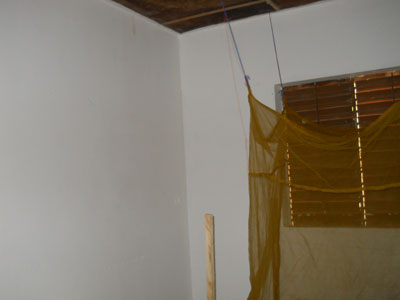
When I first looked at the inside the house I thought it was filthy. After careful examination I discovered that it was not dirty, but that people had scrubbed the walls clean and in the process they had removed the paint. As a result the concrete walls showed through on all the corners where there had been dirty little finger prints. It still looked like there were the marks of dirty hands, but really it was the result of scrubbing dirt off. Furthermore, there were water marks on most of the walls from rain leaking through the roof and down the walls, picking up bat poop on the way. In a word, it was revolting. Here is a picture of what the water damage looked like. It was like this if all of the rooms in the house.


This house has a tin roof with enough room between it and the walls for a kind of ceiling made out of thin pieces of plywood. Every day I would sweep around the edges of the walls and remove bat droppings and dust that had sifted down from the attic in the night. This continued even after the bats were eliminated. When the Pershings came at Christmas they brought a calking gun and a number s tubes of calk. Jonathan sealed the edges of the ceiling in the living room, kitchen and bathroom, and, later on, I did the bedrooms. It is amazing what a difference that has made. The only thing to sweep up now is the dust that blows in through the windows. In addition to calking, on Christmas Eve and Christmas Day the Pershing family painted the living room and kitchen. What a difference! Here is the "after" picture of the same wall:


This picture also caught the corner of my mosquito net incase you are wondering what that thing is in the right of the picture. I no longer feel like I am living in slum housing. I have continued the painting project and now all the rooms are finished. I have hung a few decorations on the walls of the living area, and it now feels like a home.

Paint
The paint here is interesting. It comes in 30 liter cans, costing about $22 a can. That is a lot more paint than you could get for $22 in the states! It is very thick and cleans up with plain water. It is easy to wipe up drops of paint that get past the drop cloth, even after they are dry. I used a bowl to put paint in and, when the paint dried on it. I thought it would be a total loss. I left it in a bucket of water over night and the paint slid right off. On the other hand, I will not be able to wash the walls or I will wash off the paint, like when the folks cleaned up my house before I arrived. I am trying very hard not to touch the walls!

Checo
I mentioned that I now have a hangar, which, for my house, is a kind of roof over the “front porch” of the house. It is a frame of tree branches covered with checo (pronounced seko), big mats woven of grass. The checo is used for roofing material in traditional houses, covering for the stalls where people sell things at the market, storage bins for grain, and, of course hangars. After the grain is harvested there are tall grasses (6 feet or so tall) that people go out a collect, then weave into these mats. Here is an example of checo used almost like a wall.


The fact that one layer of checo would not keep the rain off is not an issue since there is never rain this time of year. What you want is shade! If you were using it for the roof of a house you would use several layers and it would only leak a little bit. Almost all the houses in my region have tin roofs but the rooms we stayed in when we went to the animal park at Arly had roofs made of 6 or 8 layers of checo.

My hangar


The hangar was built with branches cut right off the tree, not given any time to dry out. Not surprisingly, the weight of the checo has bent the branches a bit and I had trouble opening my front door. Fortunately my Burkinabè son, Prosper, and one of his friends figured out how to correct the problem. First they stuck other branches up on top of those used originally to raise the roof a bit, but after a week of two, the door was hitting the branches again. The current solution has been to add a new prop to hold the whole thing up. It is a forked branch sitting in a can that used to hold dry milk. We shall see how long that works. It is really great to have someone who takes care of me as if I were his mother!

Friday, February 25, 2011

Moringa Trees

Weather, again
The weather has been staying pleasantly cool here, low 70s in the mornings and most days no more than 90-95 degrees in the afternoon, although it did reach 100 one day. As long as it cools off at night I will have no complaints. I just remember that my original assignment was supposed to be Mongolia and think about how much I hate to be cold. There it might be -40 degrees right now, so I am happy to be here. Some days there have been real clouds, not just dust in the air, which helps keep it cooler. We actually had about 15 seconds of a shower the other day, a very rare event this time of year. At first I did not believe I was really hearing rain on the roof, but I got outside before it stopped and it was real.

With the hot dry season approaching the trees are blooming and making seeds to put down before they go dormant in the heat. The sweet smell in the air makes me think of spring back home. Leaves are beginning to fall from most of the trees. I understand the Mangos keep their leaves, but most of the other trees drop them in preparation for this time of stress, just like our trees drop them in the fall to get set for winter.

Moringa trees
Speaking of trees, have I told you about moringa trees? These are the miracle trees the Peace Corps is encouraging volunteers to promote with the Burkinabè. They are drought resistant, fast growing trees that have other great virtues. The biggest one is that the leaves contain lots of good things. Here are the statistics:
If you compare100 grams of moringa to 100 grams of these other things you can see how good moringa is
7 times the vitamin C of oranges
4 times the calcium of milk
4 times the vitamin A of carrots
3 times the potassium of bananas

25 grams of leaves a day will give a child the following % of recommended daily allowances: protein 42%
Calcium, 125%
Magnesium 61%
Potassium 41%
Iron 71%
Vitamin A 272%
Vitamin C 22%

The trick is to get the Burkinabè women not to cook them so long that they cook out all of the good stuff. The usual cooking method involves hours of cooking things over a fire to make sauce for the to. You have to get people to add the morenga at the last minute so that people get the nutritional value.

Apparently you water the morenga trees a bit if you want them to keep their leaves all year, but if you want them to go to seed, you have to stop watering them. I have a stash of seeds and I would like to pant them in my courtyard, but I have to do that good old soil preparation and dig big holes first. Me dig the holes? No way in this dirt, but I have a friend who has dug a few for me. Now he is looking for well rotted manure so that there is fertilizer for the seeds. I may get trees planted by the rainy season.

Malnutrition
I have talked before about the malnutrition here and my visit to the center for malnourished babies that is sponsored by the Catholic Church in town. It is actually supported by donations from European countries, mostly from Italy I think, which is the home of the order that founded the church here. When people take babies there for help with nutrition they learn how to make a kind of baby cereal from local ingredients, and one of the recipes uses morenga leaves. Again the secret is not to boil it to death, as the Burkinabè tend to do. With malnourished babies you usually have malnourished mothers as well, so you need to convince the mothers that they need to eat well to provide good breast milk. Another thing I have learned is that mothers often give their very young babies water in addition to breast feeding them. This is a dangerous practice because of the contamination of the water sources here, and also because it fills the baby‘s stomach. Then the baby does not drink as much breast milk, and the mother produces less.

Non Peace Corps Volunteers
I recently encountered a couple of other nasaras (white people, foreigners) riding bicycles down the dirt road that passes my house. I stopped to greet them and find out who they were and what they were up to. She is a French pediatrician, newly retired, who is volunteering at the center for malnourished babies. Her husband is an agriculturist who has been doing some training about farming and also helping with the garden at the medical center.. They have been here for almost two months and this was the first time I had encountered them. They had been riding up and down the highway and finally discovered this safer dirt track. I invited them to my house for lunch Sunday and I was pretty proud of my menu. It was all local food except for the seasonings which Janet had sent me. I get a piece of goat meat, cut out the good bits and fried them up with onions. Then I added water and rice, along with a mixture of herbs of Provence, and it made a yummy casserole type dish. Add to that cooked carrots, local bread, and a lettuce and tomato salad, and it was not a bad lunch if I do say so myself. It was a very pleasant afternoon, but, unfortunately it was their last week here so we will not be getting together again. Too bad. It was good practice for my ear listening to good French, and they were interesting folks.

The pediatrician was talking about some of the things I mentioned above about malnutrition and giving babies water. She also told about the family’s lack of a sense of urgency if a child is sick. One child was brought to the center, so ill it finally died. When she asked how long the child had been sick, the mother said about 7 months. Can you imagine watching a child get sicker and sicker and doing nothing? Maybe they had tried other things, like traditional medicine and had only come to the western medical place as a last resort. Maybe they kept thinking if they gave it enough time the baby would improve. Maybe it was a matter of not having the small amount of money it takes to get medical help. I have no information, but you have to wonder what they were thinking.

Wednesday, February 16, 2011

Time

Time in Burkina Faso
I am sure you have all heard that the American view of time is different from the view of time in developing countries. I have just had a couple of examples that I will tell you about.

I had an appointment for 9:00 with the director (principal) of an elementary school. I went there on the appointed day at 9:00 and was told by one of the teachers that he had left, and maybe he was over at the health center. I went over there to see if I could find him. They were doing annual physical checkups, with people lined up at various stations, like the eye chart with the Es that face different directions. I didn’t see him in the crowd, but I was explaining to someone who I was looking for and he said, “Oh there he is, just arriving at the school.” I went back over there and the director told me he had received a notice from the Inspector (superintendent of schools) that there would be a meeting that day at 9:00 so we could not meet after all. Come back at 16:00 (4:00 pm). I am sure the teacher who told me he was not there called his cell phone about it and he left his meeting with the Inspector to come tell me we could not meet, or was also late to that meeting.

I arrived at the school at 3:50 and waited around until 4:30. Then I sent him a text saying that I was there and that if this is not a good time, tell me when I could see him. Within 5 minutes he appeared on his moto, shopping bags in hand. He said the meeting at lasted until 1:30. I guess that means he needed to take his 3 hour lunch break late. (Yes there is a 3 hour break in the middle of the school day here, to let the children and teachers go home for lunch and a rest in the heat of the day.)

The second example is even worse. Someone asked me to be somewhere at 8:00 am for a meeting on a particular day and, when she did not show up after 2 hours, I called her. She told me the meeting had been changed to the following day. I had some things I wanted to discuss with her rather than in the meeting with others so she said to be there at 7:20 and we could talk before the meeting. I was there at 7:15 and she arrived at 8:00 so we did not get a chance to talk until afterwards. Another day she and I had a meeting scheduled with a group of girls at the private college (junior high school). She was supposed to stop at my house at 7:00 so we could discuss the plan for the meeting that was to be at 8:00. When she had not arrived by 7:30 I called her and told her I would ride my bike to the school and meet her there. No, no, no, she said, I am on my way. Wait for me. So I waited at my house and she finally arrived at 9:30. We got to the school at 10:00, after I convinced her it would be a good idea to go straight there rather than stopping off to see some folks along the way. We arrived at 10:00 for this 8:00 meeting. I had expected all the girls to have given up and gone home, but there were actually 50 girls sitting around waiting for us. Amazing.

On the other hand, I have had a couple of meetings with a man who spent quite a few years in the US and he has been early for the three meetings we have had. As he says, in the US people say “Time is money.” Think about the value of people’s time in the US considering the salary of each person waiting at a meeting place for someone who is late. It is certainly true that, if you consider the value of their work they could have done in the time they are waiting for late comers, money is being wasted.

I was warned to expect people to be late here and for meetings to be very late in starting, an hour or more not being unusual. What I was not prepared for was people who know they will not be there for a meeting with you who do not bother to let you know about that. It is one window into the cultural differences. This being late for meetings is chronic. I have heard people say they should tell people to get to a meeting an hour before they really want to start. To my way of thinking, that just rewards late comers and makes the problem worse, but it is such an ingrained part of the culture I doubt if I can fight it. I was able to convince my language tutor that if we agreed to meet at 3:00 I expected him to appear at 3:00, not 3:30 or 4. Maybe it is knowing that the job might disappear if he did not conform to that American standard, or maybe he is more westernized, but he is always on time now. It is possible for Burkinabé to arrive when expected, just not the usual custom.

I think I have already mentioned that the same thing happens in church. I arrive at 7:30 and usually the pastor and one or two other people arrive about then. They begin the service and after a half hour or so there are 30 people in the room and the choir has started to trickle in. By 9:00, when the service is almost over, there are probably 60 there. Some of those late comers may actually be arriving early for the next service that is in Moore, but I don’t think so.

One of the reasons things tend to be late here is that people stop along the way to chat with all the people they know. When they arrive, there is the ritual of greeting everybody in the room with good morning, how are you, how is the family, did you sleep well, etc. These ritual greetings are a deeply ingrained part of the culture and people tell me the relationships take precedence over any idea of time. Good thing or bad thing? I am not sure I will adapt to it here. I am sure when I get home I will still be that compulsively prompt person you all know who has been indoctrinated with idea that if you are not early, you are late, because only one person can walk through the door exactly on time.

Sunday, February 6, 2011

More Changes in the weather and IST

More Changes in the weather
As I have mentioned, in December the weather got cooler, rather suddenly. Some days you can barely see the sun because of what appears to be low hanging clouds, but is actually dust in the air. The feeling is of an over cast sky in the states, but it is kind of like there is smoke or fog in the air. I guess it is the African version of smog. It is not from emissions from gas burning vehicles, but the dirt that is blowing in the wind because of the loss of ground cover and trees.

I keep thinking of that old song “Dust, dust , dust in the skies, dust in the heavens, dust in my eyes. oh dust, dust can this be, can this be eternity? Oh Lord, have mercy on poor me” Most of you are too young to have heard it. I think it was popular for a while in the late 40s or early fifties.

The dust is hard on the eyes, hard on the lungs, and gets on everything. When you ride a bike or moto on the dirt roads, they kick up quite a cloud of dust. Motos going fast are particularly bad. People wear a face mask/dust filter over their mouths and noses to keep from breathing in the dust. Sometimes they have the kind you buy at a hardware store to use when you are working in your shop, but mostly they use the blue sleeping masks you get on overseas flights. I guess someone at the airport collects them from the trash and sells them to folks. I am sure that most people have no idea of their original use because I have discussed it with a few and they were very surprised, and perhaps a bit puzzled. Why would you want to sleep when there is light?

WE have more dust and wind in the future, I understand. In the hot season (March, April and May) the wind slows from the north, across the Sahara desert, picking up lots of sand and dust as it comes this way. I understand it can be like a whiteout snowstorm, only red. Something to look forward to in a house that does not have glass windows but just metal shutters

For a while the days were on the cool side, only getting up to 80 or so. From here on out it will begin to get hotter and hotter. I am sure you will hear more about the heat in these blogs as the days and nights get to be really hot. For now the weather is quite comfortable for me most of the time. It was actually 68 degreesw Sunday morning when I headed out to church. (Thanks for the thermometer, Garret-Larsens). The Burkinabè find it quite cold and wear their warmest clothes. For some, mostly the men, that means knitted stocking caps and heavy winter jackets. Women tend to layer their pagnas and to use them as shawls, so a woman might have two or three pagna “skirts” and a couple wrapped around her shoulders. I sometimes wrap one around me, over my slacks, in the morning if I am feeling cold. It is surprising how warm multiple layers of cotton cloth can be.

It is really strange to get up in the morning and not to give much thought to what the weather except to wonder how hot it will get. At home, when I first got up, I always put on the TV news in the morning to hear what the weather would be like before I decided what to wear. Here, for the next three or four months, there will only be a question of how hot it is going to be.

In Service Training (IST)
It has been several weeks since my last post. That is because, after four months at our sites, the Peace Corps brought our various program groups together for two more weeks of training. The first week for Girls Education and Empowerment was held at the conference center I described in the last blog. We learned about the reporting expectations, which look like they will be a bit of a pain, but this is a government agency, after all. In order for the Peace Corps to get funded they have to document for congress what the volunteers are doing and how many people they have worked with, etc. It starts with each volunteer filling out a report his or her activities for a four month period. Of course there is a form to fill out. I feel sorry for folks who did not bring a computer or who do not have internet access because you have to go through a sequence of forms, selecting from drop-down menus or filling in blanks. Among other things you have to indicate the number of people who participated in each activity. I am really glad I followed the Burkinabè custom of having people sign an attendance sheet at meetings so I know how many people were there.

We also had presentations from second year volunteers about activities they had done. There was a Burkinabè English teacher who described the kinds of activities he has done with his English clubs and a third year volunteer (yes, a lot of people here sign on for an additional year) who is working with an organization called Friends of African Village Libraries. There are not many libraries anywhere in Burkina Faso, and reading is not a major activity, even for the well educated. Very few smaller towns or villages have libraries, but I sure wish there were one in my village! The ones that do exist have children’s books in local language as well as French, and it would be a great way to practice Moore. It turns out that such books are very expensive because there is a very small market for them, so they are not produced in large numbers.

We had a session on gardening, hoping volunteer would start a garden to show people how to use compost and how to do drip irrigation. I don’t think I will be doing that, but you never know. The most fun was the session on soap making. It is one of the most popular income generating activities. You can seel the product for twice what the ingredients cost, so it is a pretty good deal. The liquid soap is easy to make and the ingredients are even safe for children to handle. I would not want to fool around with the hard soap which requires rubber gloves and a good deal of care, although the soap you get in the end is pretty nice.

I am going to stop my discussion of IST here and continue in the next blog. Hope you all are enjoying all that cold, snowy weather. Just imaging a place where you have to put on a einter coat when it is 70…… I’m there!